
A Material Chosen for Real Industrial Conditions
Carbon steel is often selected not because it is the most advanced material, but because it perfectly fits real industrial needs.
Carbon steel provides strong mechanical properties, allowing the exchanger to withstand internal pressure, thermal stress, and vibration during continuous operation. It is easy to fabricate, weld, and machine, which makes manufacturing more efficient and quality more controllable.
In addition, carbon steel has good thermal conductivity compared with many alloy materials, enabling stable heat transfer performance without excessive material cost.
Typical Industries That Rely on Carbon Steel Units
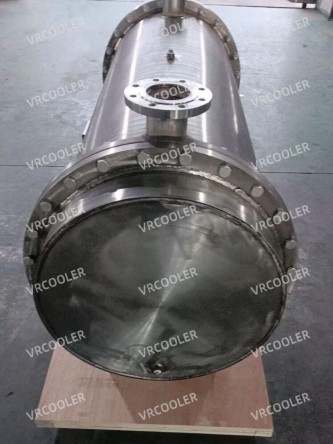
Carbon steel shell and tube heat exchangers are used in almost every traditional process industry.
In oil and gas, they are widely applied as crude oil heaters, gas coolers, lube oil coolers, and condensers.
In power plants, they serve as feedwater heaters, auxiliary coolers, and heat recovery units.
In chemical plants, they are used for solvent heating, product cooling, and process temperature control.
In general industry, they appear in HVAC systems, compressed air cooling, and boiler auxiliary equipment.
These applications share one thing in common: stable operating conditions without extreme corrosion.
Structure That Balances Simplicity and Strength
The structure of carbon steel shell and tube heat exchangers follows the classic design logic.
A cylindrical carbon steel shell contains a tube bundle made of carbon steel or mixed materials. Tube sheets, baffles, and nozzles are also usually carbon steel. This unified material system avoids thermal mismatch and reduces mechanical stress.
The design can be fixed tube sheet, U-tube, or floating head, depending on thermal expansion and maintenance requirements. This structural flexibility makes carbon steel exchangers adaptable to many process scenarios.
Why Carbon Steel Is Still So Popular
Even with many advanced materials available, carbon steel remains the mainstream choice.
Cost efficiency
Carbon steel is significantly cheaper than stainless steel or titanium, especially for large equipment.
Manufacturing convenience
Welding, forming, and machining are mature and standardized.
Reliable performance
For non-corrosive or mildly corrosive fluids, carbon steel provides long service life.
Easy maintenance
Spare parts are widely available and repairs are simple.
These advantages make carbon steel the first option for budget-sensitive projects.
Limitations and Smart Design Solutions
Carbon steel is not suitable for every situation, but its limitations can be managed through smart engineering.
For mildly corrosive media, internal coating or lining can be applied.
For high-temperature systems, thicker shells and reinforced structures are used.
For mixed fluid systems, carbon steel shell with stainless steel tubes is often selected.
Through proper material matching and surface treatment, carbon steel shell and tube heat exchangers can safely operate in a wide range of industrial environments while keeping overall investment under control.