
Flooded Evaporator of a Water-Cooled Centrifugal Chiller
A flooded evaporator is a critical heat exchanger component in water-cooled centrifugal chillers—systems widely used for large-scale cooling (e.g., commercial buildings, data centers, industrial processes). Unlike "dry expansion" evaporators (where refrigerant partially vaporizes as it flows through tubes), a flooded evaporator operates with its heat-transfer tubes completely submerged (flooded) in liquid refrigerant. This design maximizes heat transfer efficiency, making it ideal for the high cooling loads handled by centrifugal chillers.
Core Principle: How a Flooded Evaporator Works in a Water-Cooled Centrifugal Chiller
Water-cooled centrifugal chillers use a vapor-compression refrigeration cycle to cool a "chilled water" loop (supplied to spaces/equipment) and rely on a "condenser water" loop (cooled by a cooling tower) to reject heat. The flooded evaporator sits at the low-pressure, low-temperature side of the cycle and facilitates heat transfer between the chilled water (the "load" to be cooled) and the liquid refrigerant. Here’s its step-by-step operation:
Refrigerant Supply to the Evaporator:
High-pressure liquid refrigerant from the condenser flows through an expansion valve (or orifice plate)—a device that reduces its pressure and temperature, converting it into a low-pressure, subcooled liquid (or a liquid-vapor mixture). This low-pressure refrigerant is then fed into the bottom of the flooded evaporator’s shell.
Flooding the Tubes:
The evaporator consists of a sealed shell (typically carbon steel or stainless steel) containing hundreds of thin-walled tubes (often copper or titanium, for corrosion resistance). Refrigerant fills the shell to a controlled level (via a liquid level control valve), completely submerging the tubes. The liquid level is critical: too low, and tubes are exposed (reducing heat transfer); too high, and liquid refrigerant may be sucked into the centrifugal compressor (causing "liquid slugging," a severe damage risk).
Heat Transfer: Chilled Water Cooling:
The chilled water loop (warm water returning from the building/process, ~12–15°C) flows inside the submerged tubes. As the warm water passes through the tubes, heat is transferred through the tube walls to the cold liquid refrigerant (typically at ~4–7°C, depending on the desired chilled water outlet temperature).
The refrigerant absorbs this heat and boils (vaporizes)—a phase change driven by latent heat transfer (far more efficient than sensible heat transfer alone).
The chilled water, having lost heat, exits the evaporator at a lower temperature (~6–8°C) and is pumped back to the cooling load.
Vapor Separation and Compression:
The refrigerant vapor (now saturated or slightly superheated) rises to the top of the evaporator shell, where a vapor-liquid separator (built into the evaporator design) ensures only vapor is drawn into the centrifugal compressor. The compressor then compresses the vapor to high pressure and temperature, sending it to the water-cooled condenser to release heat and condense back into liquid—completing the cycle.
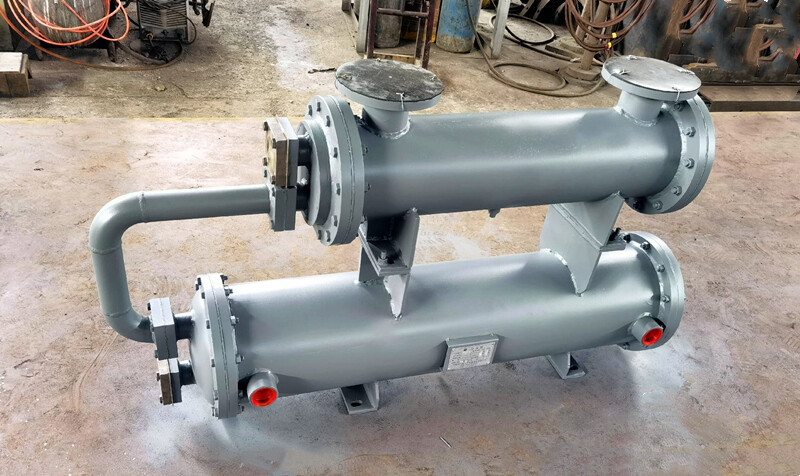
Advantages of Flooded Evaporators in Water-Cooled Centrifugal Chillers
Flooded evaporators are preferred for centrifugal chillers due to their superior performance and reliability, especially for large cooling loads
Higher Heat Transfer Efficiency:
Submerging tubes in liquid refrigerant ensures 100% tube surface contact with the refrigerant. Latent heat transfer (from boiling) is far more efficient than the sensible + partial latent transfer in dry expansion evaporators. This translates to smaller evaporator size for the same cooling capacity or higher capacity for the same size.
Stable Chilled Water Temperature Control:
The large volume of liquid refrigerant in the shell acts as a "thermal buffer," reducing temperature fluctuations in the chilled water outlet. This is critical for applications requiring precise cooling (e.g., data centers, medical facilities).
Reduced Refrigerant Pressure Drop:
In dry expansion evaporators, refrigerant flows through narrow tubes, creating high pressure drop (which wastes compressor energy). In flooded evaporators, refrigerant boils in the shell (no forced flow through tubes), minimizing pressure drop and improving overall cycle efficiency.
Compatibility with Low-Temperature Refrigerants:
Centrifugal chillers often use low-pressure refrigerants (e.g., R-134a, R-513A, or low-GWP alternatives like R-1234ze). Flooded evaporators excel with these refrigerants, as their large volume can accommodate the low refrigerant density and high vapor volume of these fluids.
Lower Risk of Tube Fouling Impact:
While fouling (mineral deposits, debris) on tube surfaces still reduces efficiency, the high heat transfer rate of flooded evaporators means fouling has a smaller relative impact compared to dry expansion coils.