
- Product Knowledge
Shell-and-tube heat exchangers are widely used in oil refineries, power plants, chemical plants, oil-and-gas facilities, marine systems and many other industrial processes. One reason they are so popular is that the design can be adjusted for different pressures, temperatures, fluids, maintenance requirements and space limitations. A shell-and-tube exchanger is not just one standard product; it is a combination of front head type, shell type and rear head type.
In TEMA-style design, the exchanger configuration is normally described by three letters. The first letter shows the front-end stationary head, the second letter shows the shell type, and the third letter shows the rear-end head type. For example, a BEM exchanger uses a bonnet front head, one-pass shell and fixed tubesheet rear end. A BEU exchanger uses a bonnet front head, one-pass shell and U-tube bundle. An AES exchanger uses a channel with removable cover, one-pass shell and floating head with backing device.
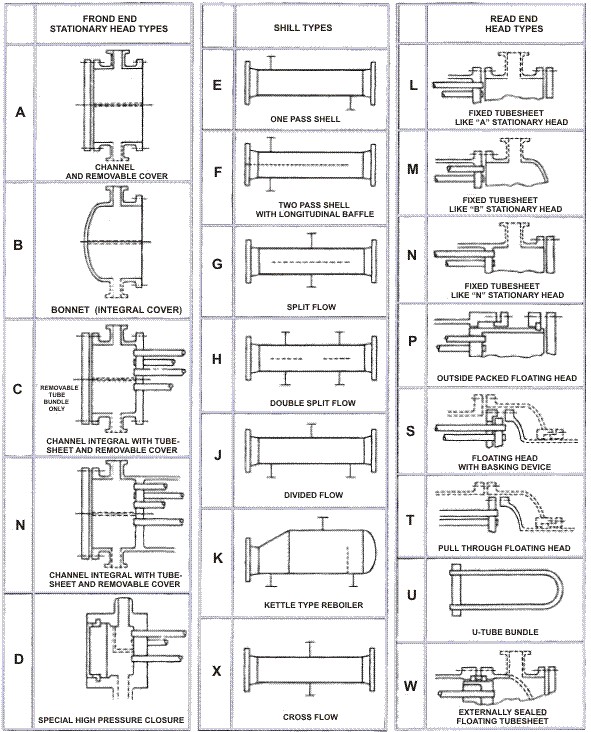
The front head is the part where the tube-side fluid enters and leaves the exchanger. Common options include removable channel covers, bonnet-type heads and special high-pressure closures. A removable channel cover is useful when regular tube-side inspection and mechanical cleaning are required. A bonnet-type head is simpler and cost-effective, but access to the tube side usually requires more disassembly. For high-pressure refinery or chemical service, a special closure may be selected to handle severe operating conditions.
The shell type controls the flow path of the shell-side fluid. The most common design is the E shell, or one-pass shell, because it is simple, reliable and suitable for many heating and cooling duties. An F shell provides two shell-side passes and can improve thermal performance when a higher temperature cross or closer approach is required. Split-flow and double-split-flow shells, such as G and H types, are often used where pressure drop must be controlled. K shell designs are used for kettle reboilers, where vapor disengagement space is needed above the tube bundle. X shell cross-flow designs are often selected when very low shell-side pressure drop is important.
The rear head design has a major influence on maintenance, thermal expansion and cost. Fixed tubesheet exchangers are among the most economical and compact configurations. They are suitable when the temperature difference between shell side and tube side is not too large, and when the shell-side fluid is relatively clean. However, because the tube bundle is fixed to the shell, the bundle cannot be removed for shell-side mechanical cleaning. If thermal expansion is significant, an expansion joint may be required.
U-tube exchangers are another common industrial configuration. In this design, the tubes are bent into a U shape and fixed to only one tubesheet. This allows the tube bundle to expand freely, making the design suitable for higher temperature differences. U-tube bundles are also removable, which is helpful for maintenance. The limitation is that the inside bend area is more difficult to clean mechanically, so U-tube exchangers are usually better for relatively clean tube-side fluids.
Floating head exchangers are selected for more demanding duties. The rear tubesheet is allowed to move, so the tube bundle can handle thermal expansion without creating high stress. The bundle can also be removed for inspection and cleaning, making floating head designs suitable for fouling services, high-temperature processes and refinery applications. Compared with fixed tubesheet or U-tube designs, floating head exchangers are more complex and more expensive, but they provide excellent maintainability and operating flexibility.
For refinery service, floating head and U-tube exchangers are often preferred because process fluids may be hot, dirty or corrosive. Crude oil coolers, overhead condensers, amine coolers, hydroprocessing exchangers and reboilers often require careful selection of tube material, baffle design, sealing arrangement and cleaning access. In power plants, shell-and-tube exchangers are used as turbine oil coolers, closed cooling-water exchangers, gland steam condensers, generator coolers and auxiliary coolers. In marine systems, compact and serviceable designs are important for jacket-water coolers, lube-oil coolers, fuel-oil heaters, fresh-water coolers and steam condensers.
The best shell-and-tube configuration depends on the actual working condition. Important factors include fluid type, fouling tendency, design pressure, operating temperature, allowable pressure drop, material compatibility, cleaning method and installation space. A low-cost fixed tubesheet exchanger may be suitable for clean water-to-water cooling, while a removable bundle or floating head exchanger is a better choice for dirty oil, seawater, high-temperature process fluids or services requiring regular maintenance.
At Vrcoolertech, shell-and-tube heat exchangers can be customized according to the required TEMA configuration, material and process duty. Depending on the application, we can design fixed tubesheet, U-tube, floating head, removable bundle, kettle reboiler and other industrial shell-and-tube heat exchangers using carbon steel, stainless steel, duplex stainless steel, copper alloy, titanium, Hastelloy and other materials. A properly selected configuration helps improve heat transfer performance, reduce downtime and extend the service life of the equipment.