
Heat Transfer Fundamentals in Crude Oil Preheating Systems
The main purpose of a crude preheat exchanger is to transfer thermal energy from hot process streams to colder incoming crude oil before it enters the refining stage. This process plays an important role in improving energy utilization within the refinery.
Heat transfer inside the exchanger occurs through several mechanisms:
Conduction through the metal walls of the heat exchanger tubes.
Convection between the flowing fluids and the tube surfaces.
Turbulence generated by fluid motion, which improves the heat transfer coefficient.
When these mechanisms work together, heat moves efficiently from the hot stream to the crude oil. As a result, the crude oil temperature rises gradually before entering the furnace or distillation unit.
This preheating process significantly reduces the energy required for further heating.
Heat Transfer Fundamentals in Crude Oil Preheating Systems
The main purpose of a crude preheat exchanger is to transfer thermal energy from hot process streams to colder incoming crude oil before it enters the refining stage. This process plays an important role in improving energy utilization within the refinery.
Heat transfer inside the exchanger occurs through several mechanisms:
Conduction through the metal walls of the heat exchanger tubes.
Convection between the flowing fluids and the tube surfaces.
Turbulence generated by fluid motion, which improves the heat transfer coefficient.
When these mechanisms work together, heat moves efficiently from the hot stream to the crude oil. As a result, the crude oil temperature rises gradually before entering the furnace or distillation unit.
This preheating process significantly reduces the energy required for further heating.
Tube Bundle Geometry Creating Efficient Heat Transfer Surfaces
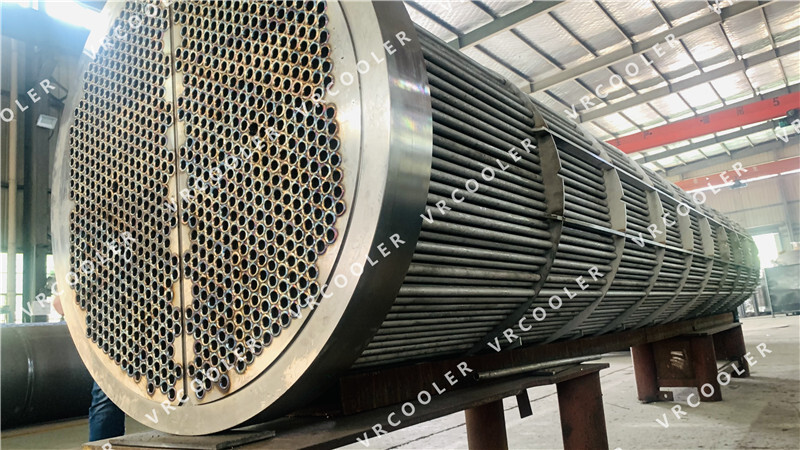
The tube bundle is the most important component of a shell and tube crude preheat exchanger. It forms the main area where heat transfer takes place.
A typical tube bundle includes:
Multiple rows of heat transfer tubes
Tube sheets fixing the tubes at both ends
Support plates maintaining tube spacing
The arrangement of tubes inside the bundle is carefully designed to maximize heat transfer area while maintaining proper fluid flow.
Depending on the process requirements, engineers may choose different tube layouts such as:
Triangular pitch arrangement
Square pitch arrangement
Each layout offers different advantages in terms of heat transfer efficiency, fouling resistance, and ease of maintenance.
Internal Baffle Structures Enhancing Flow Dynamics
Inside the shell, baffles play an essential role in guiding the flow of fluids.
Baffles serve several purposes:
They force the shell-side fluid to flow across the tubes rather than straight through the shell.
They increase turbulence, which improves heat transfer efficiency.
They provide structural support to the tube bundle and reduce vibration.
The spacing and orientation of the baffles must be carefully designed. If the spacing is too large, heat transfer efficiency decreases. If the spacing is too small, pressure drop increases.
Therefore, the correct balance between heat transfer performance and pressure loss must be achieved during engineering design.
Precision Manufacturing Supporting Thermal Performance
Even the best design cannot achieve optimal performance without high-quality manufacturing.
During production, several key processes must be carefully controlled:
Accurate drilling of tube sheet holes
Precise tube insertion and expansion
High-quality welding of shell sections and nozzles
Installation of internal baffles according to design specifications
Strict dimensional control ensures proper alignment of all internal components. This prevents flow imbalance and guarantees that the exchanger performs exactly as designed.
Precision Manufacturing Supporting Thermal Performance
Even the best design cannot achieve optimal performance without high-quality manufacturing.
During production, several key processes must be carefully controlled:
Accurate drilling of tube sheet holes
Precise tube insertion and expansion
High-quality welding of shell sections and nozzles
Installation of internal baffles according to design specifications
Strict dimensional control ensures proper alignment of all internal components. This prevents flow imbalance and guarantees that the exchanger performs exactly as designed.