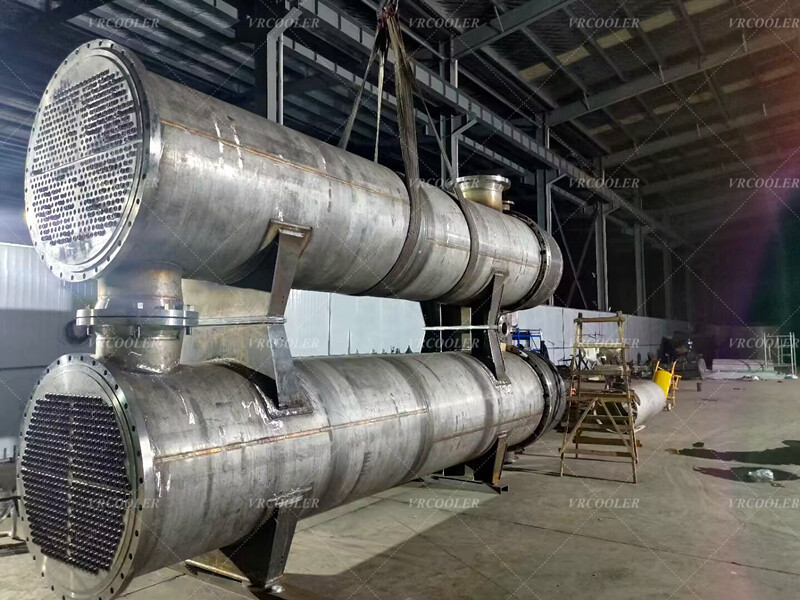
A feed-effluent heat exchanger is a heat-recovery unit that transfers heat from a hot process stream leaving a reactor or processing unit—the effluent—to a colder incoming feed stream. It recovers energy that would otherwise be rejected through a cooler or condenser.
In a refinery, cold feed passes through one side of the exchanger while hot reactor effluent flows through the other. The streams remain physically separated, but heat passes through the tube walls. The feed is preheated before entering a fired heater or reactor, while the effluent is cooled before downstream separation, condensation or product treatment.
Feed-effluent exchangers are commonly used in hydrocracking, hydrotreating, catalytic reforming and other high-temperature refinery processes. Several shell-and-tube exchangers may be connected in series when a single unit cannot provide the required heat-transfer surface or pressure containment.
Their principal benefits include:
- Reduced fuel consumption in the fired heater
- Lower cooling-water or air-cooler duty
- Improved process-energy efficiency
- Reduced operating costs and emissions
- More stable reactor-inlet temperature
- Controlled cooling of the reactor effluent
A counter-current flow arrangement is generally preferred because it provides a closer temperature approach and greater heat recovery. The choice of shell-side and tube-side allocation depends on pressure, temperature, fouling, corrosion, phase change and maintenance requirements. High-pressure feed is often placed inside the tubes because smaller-diameter tubes are more economical for containing high pressure, although the final arrangement must be determined through detailed design.
Feed-effluent exchangers operate under demanding conditions that may include hydrogen, hydrogen sulfide, corrosive compounds, two-phase flow, high temperature and severe fouling. Proper material selection, vibration analysis, thermal-expansion control and leak detection are therefore essential. Fouling or internal leakage can reduce heat recovery, increase fired-heater duty, disturb reactor temperatures and contaminate process streams.