
For a water-cooled CO₂ compressor intercooler or aftercooler, the most suitable starting configuration is usually:
Recommended configuration: AEL or BEM
TEMA identifies the first letter as the stationary head, the second as the shell and the third as the rear head. Its current standard also includes an exchanger selection guide and specific provisions for Type-D high-pressure channel closures.
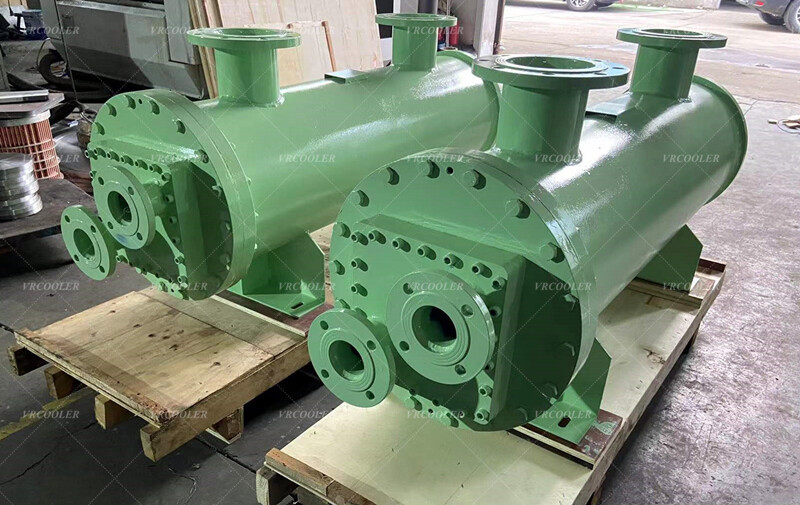
Typical clean-service selection
AEL fixed-tubesheet exchanger
- A: channel with removable cover
- E: one-pass shell
- L: fixed-tubesheet rear head with removable cover
This configuration is especially practical when cooling water flows through the straight tubes, because deposits can be brushed or hydro-jetted from either end.
Lower-cost selection
BEM fixed-tubesheet exchanger
BEM is suitable when:
- CO₂ and cooling water are relatively clean;
- the temperature difference does not create excessive differential expansion;
- shell-side mechanical cleaning is not required;
- low capital cost is important.
Large temperature difference
Choose BEU or AEU U-tube when compressor discharge temperature is high and significant thermal expansion is expected. The U-tube bundle accommodates expansion without a shell expansion joint, although the U-bends are harder to clean mechanically.
Very high-pressure CO₂
High-pressure CO₂ is often considered for the tube side, because containing pressure in small-diameter tubes can be more economical than designing a large high-pressure shell. For exceptionally high pressures, a special high-pressure closure, potentially based on a TEMA Type-D head, should be evaluated. The final fluid allocation must also consider cooling-water fouling, CO₂ pressure drop, condensate drainage and compressor-stage performance.
API 660 is the relevant shell-and-tube mechanical standard when specified for petroleum, petrochemical or natural-gas-type project service, while CO₂ compression systems commonly require intercooling and aftercooling as part of the compression train.